
Eco-E: An AI Energy Optimization Architecture Built for the Next Efficiency Layer

Eco-E: An AI Energy Optimisation Architecture Built for the Next Efficiency Layer
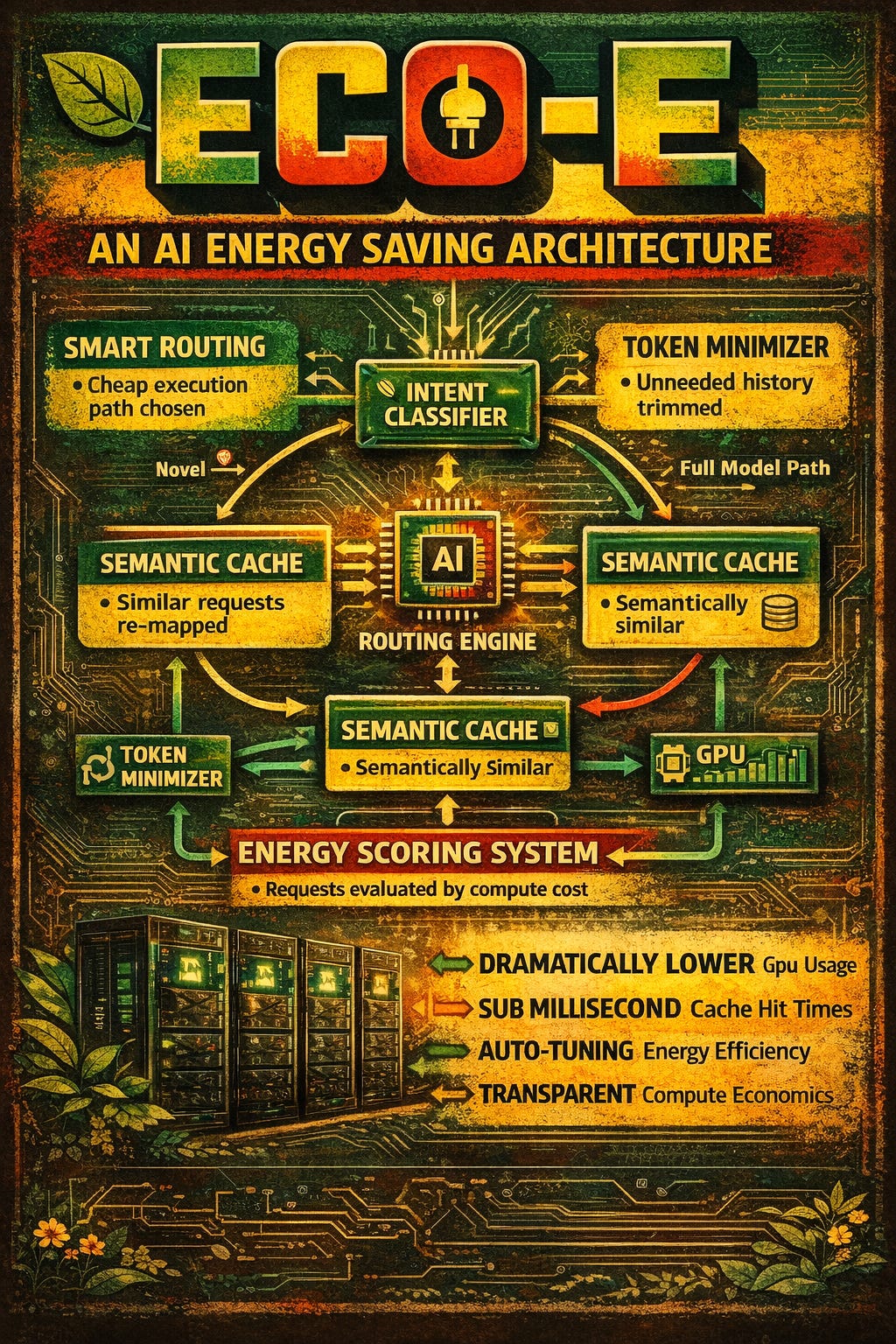
Modern AI systems are powerful, but they are also expensive in the most literal sense: compute cost, electricity consumption, and infrastructure load. As models scale and agents become more autonomous, the energy footprint of AI systems is becoming one of the central engineering constraints of the decade.
Eco-E is a conceptual architecture designed to address exactly that: reducing unnecessary AI compute through intelligent routing, caching, and workload shaping. It is not just an “optimization tool” — it is a system-level efficiency layer for AI execution itself.
1. What Eco-E actually is (architecturally)
At its core, Eco-E can be understood as a decision layer placed between user intent and model execution.
Instead of every request going directly to a large model, Eco-E introduces a control pipeline:
Core components:
Intent Classifier
Detects whether a request is simple, repetitive, or novel
Semantic Cache Layer
Stores embeddings of previous requests and responses
Reuses answers when meaning is “close enough”
Routing Engine
Chooses the cheapest viable execution path:
cached response
small model
large model (only when needed)
Energy Scoring System
Assigns a “compute cost estimate” before execution
Feedback Optimizer
Learns when high-cost calls were unnecessary
This creates a system where AI is no longer always “on full power.”
2. Why this architecture matters
Most AI systems today fail in one critical way:
They treat every request as equally important and equally complex.
That is extremely inefficient.
In reality:
40–70% of requests are repetitive or semantically similar
many queries do not require frontier model reasoning
most outputs are variations of prior patterns
Eco-E exploits this reality by shifting AI from:
“always compute” → “compute only when necessary”
That single shift is what makes it valuable.
3. Where the real energy savings come from
Eco-E saves energy in four major ways:
1. Semantic reuse (biggest gain)
Instead of regenerating responses:
embeddings match similar queries
cached answers are reused or lightly adapted
This avoids full model inference cycles.
2. Model tiering (right-size compute)
Not everything needs a large model.
Eco-E routes tasks like:
summarization → small model
structured extraction → lightweight model
reasoning → large model only
This reduces GPU time dramatically.
3. Token minimization
Eco-E compresses context:
removes redundant history
trims prompts dynamically
avoids bloated system instructions
Fewer tokens = less compute = lower energy use.
4. Predictive pre-computation
For common patterns:
responses are pre-generated
cached during idle compute windows
served instantly when requested
This shifts energy usage from peak to off-peak.
4. Why Eco-E is valuable beyond cost savings
Energy efficiency is only the first layer. The deeper value is system stability and scalability.
A. Lower infrastructure pressure
Less GPU usage means:
fewer servers needed
lower cloud costs
reduced thermal throttling
B. Faster response times
Caching + routing means:
many responses return instantly
reduced latency variance
C. Sustainable AI scaling
Without efficiency layers, AI scaling becomes linear:
more users = more GPUs = more cost = more emissions
Eco-E breaks that assumption by making scaling partially logarithmic instead of linear.
D. Predictable compute economics
Companies can estimate:
cost per interaction
energy per workflow
cache hit rates
This turns AI from a “variable cost explosion” into a controlled system.
5. What actually “saves” the Eco-E architecture
Every efficiency system eventually fails unless it is designed with constraints. Eco-E survives only if it enforces three invariants:
1. Cache correctness > cache coverage
A wrong cached answer is more expensive than recomputation.
2. Routing transparency
Every decision must be explainable:
why small model was chosen
why cache was used
why large model was triggered
3. Continuous rebalancing
Workloads shift over time:
cached patterns decay
models improve
usage changes
Eco-E must constantly re-optimize itself.
Without these, it becomes stale and unreliable.
6. Why Eco-E matters in the long term
AI systems are moving toward:
autonomous agents
continuous reasoning loops
always-on background processing
That future has one unavoidable problem:
uncontrolled energy growth
Eco-E introduces a missing layer that most architectures ignore:
The “economics of cognition”
It treats computation like a budget, not a default.
That is a structural shift.
7. Final perspective
Eco-E is valuable not because it makes AI “cheaper,” but because it makes AI aware of its own cost of thinking.
That changes the design space entirely:
systems stop overthinking simple tasks
redundancy becomes measurable
intelligence becomes resource-aware
In practical terms, Eco-E turns AI infrastructure into something closer to a living economy:
spending compute where it matters
saving it where it doesn’t
learning the difference over time